


2018 School Spending Survey Report

The Horn Book website has lots of material of interest to teachers. Here are some areas to explore. And follow us on Twitter: #lollysclass
|
Interviews with authors and illustrators Recommended books -- reviews and themed book lists |
School -- reading in school, author visits, and more Suggestion box: what else to you want to see in Lolly's Classroom? |
Disturbing (or Not?) Young Adult Fiction
I experienced Suzanne Collins’s The Hunger Games on the cusp of it becoming a must-read, a trilogy-starter, and then a film franchise.
 I experienced Suzanne Collins’s The Hunger Games on the cusp of it becoming a must-read, a trilogy-starter, and then a film franchise. I had hurried into the bookstore, reading list in hand, and interrupted the young woman shelving books. When I asked where to find the titles on my list, I mentioned that I taught English at an all-boys school. Upon hearing this, the clerk deftly changed the trajectory of the book in her hand, thrusting it toward me with the command: “If you teach middle school boys, you must read this.”
I began The Hunger Games that night, and by midweek I was in the thick of it. I mentioned to my seventh-grade class that I was reading a “really disturbing book,” and they immediately wanted to know what it was about. The next two mornings, class began with boys asking what was happening in the Games. They were as intrigued as I was disconcerted by the idea of a federally sponsored event in which children are compelled to kill one another in order to stay alive.
It was with mixed feelings, therefore, that I learned the following Monday that over the weekend several of my students had bought and read this “disturbing” book and were lending their copies to the first bidders. Even though I had taught William Golding’s Lord of the Flies to eighth and ninth graders in the past, that book was already gilded with the “classic” moniker, and thus the transformation of the characters from ordinary British schoolboys to brutal, murderous beasts had been sanctioned in English classrooms for decades. However, the year before, a parent had called the school blaming her son’s recent wet dreams on my having assigned Daniel Keyes’s classic, Flowers for Algernon, for the summer read. The school dean, who didn’t know the book, called me in to discuss the nature of it, and whether it was appropriate for thirteen-year-old boys. So I had reason to be skittish.
On the other hand, I believe it is within the English classroom that young people can confront the frequently disturbing state of being human. Often, the concepts that make us the most uncomfortable are the ones that teach us the most. At a time when teachers and librarians vie mightily for attention with video games, social media, and a myriad of extracurricular activities, a book that captivates kids is worth noting.
Equally noteworthy was the appeal of the female protagonist, Katniss. Regardless of how far society has come, few young men that I teach have read such classics as Little Women, A Tree Grows in Brooklyn, or I Know Why the Caged Bird Sings (and, in my experience, very few will choose on their own to read a book with a female protagonist). From the very first chapter of The Hunger Games, it is Katniss’s dual hunter-gatherer role and her excellent skills with a bow that keep boy readers’ attention. Unlike dramatic Jo March or introspective Francie Nolan, Katniss is an action figure, but, like those girls of yore, she has little control over what happens to her. The Hunger Games society rewards “masculine” values of physical prowess and winning above all else; these trump the “feminine” value of compassion. While the book has all the trimmings of a “male” story arc, it is ultimately Katniss’s femininity that influences the bleak and nontraditional (non-male) ending. Katniss wins, but as the trilogy moves forward, she becomes more and more of an empty symbol, the poster girl for the districts’ rebellion rather than a person in her own right.
My students’ avidity for the story outweighed my caution, and I assigned the book as required summer reading for that year’s incoming seventh graders. I also had them write the first chapter of the next book in the series (Collins’s second book, Catching Fire, was due out that fall). The writing that came in that September was some of the best I have seen from a group of students over my twenty-plus years of teaching. The Hunger Games had not only been a riveting read but it was also the perfect writing prompt. Even my most reluctant writers exceeded the four-page minimum I had set for them.
Unfortunately, one of my most creative writers had not been allowed to read the book. His mother met me in the hall the day before school started and was appalled that I would assign this book that her mother, the owner of an independent bookstore, refused to sell. She had chosen an alternative, safer read for her son, which was too bad, as all the other boys were bursting to share their sequel chapters. On a certain level, I could relate, as I, too, had found this book disturbing. But these pubescent boys were experiencing it differently from us midlife mothers.
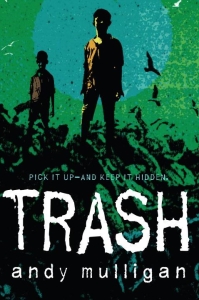 I had a similar experience with Trash by Andy Mulligan, a book given to me by a fifth grader who entreated me to “read it now!” Just as with The Hunger Games, I was initially stunned that a young boy could be so enthralled by a book with such a raw setting and characters. However, unlike The Hunger Games, which takes place in a futuristic world, Trash takes place in a near-future, unnamed but all-too-plausible Third-World city. The main characters, three young boys, Raphael, Gardo, and a boy known as Rat, live at the base of a dump heap and spend their days, as do the rest of their neighbors, trash-picking:
But there’s a lot of things hard to come by in our sweet city, and one of the things too many people don’t have is toilets and running water. So when they have to go, they do it where they can. Most of those people live in boxes, and the boxes are stacked up tall and high. So, when you use the toilet, you do it on a piece of paper, and you wrap it up and put it in the trash…It’s [the dumpsite community] a place they call Behala, and it’s rubbish-town.
As the story goes on, readers follow as the boys flee from the authorities while solving the mystery of a wallet they find in the dump. Like Dante’s Inferno, there are levels in Behala; Rat does not sleep in a box like the others, he lives in a hole dug underneath the mountain of trash; Raphael ruminates; “I would not have lived there — anywhere would have been better. For a start it was damp and dark. For another thing, I would have been scared that the trash above would fall and pile up down the stairs, trapping me.” Later in the narrative, the boys visit a prison, venturing deeper into the inferno:
I had expected cells, but all I saw was cages. They were on my left and right, and they were the types of cages you might put lions and tigers in, in an old-fashioned zoo. They were just high enough for a short man to stand up in, and they were about four metres long, maybe two metres deep. I looked up and saw that these cages were stacked three high, with ladders up the sides. They continued in long rows, and I could see that there were alleyways between them. It was so terribly hot. As we passed the alleyways, I saw that they led you deep into more cages. It was like a warehouse, but every cage held people.
This was the book about which my young student was so ardent?! I kept reading because, like The Hunger Games, Trash is a mesmerizing page-turner. At the same time, I shuddered at the fact that both books’ target audiences are so young — too young? — to be experiencing such disturbing worlds. Like my student who so exuberantly extolled the book’s virtues, I, too, appreciated the heroism of these “rubbish boys,” much as I had cheered for Katniss. Along with admiration, I felt great empathy for these destitute characters who had street-smarts, but who couldn’t read because school was so inconsequential to their survival. Was this the kind of story to bring to my wide-eyed preteens? And, always in the back of a teacher’s mind: what will the parents think?
By the time I finished the book, however, I had decided to read it aloud to my sixth graders in September. Raphael, Gardo, and Rat were around the same age as my boys. This appeared to be the only similarity to my wealthy prep-school kids, who have game systems and DVD players in their bedrooms and who take spring breaks in the Caribbean. And yet, ironically, my class not only embraced but also envied the independence of the trash boys. To them, the dumpsite setting was just as fantastical as Hogwarts. As in The Hunger Games, my students were attracted to the protagonists’ freedom and independence in not only taking on the bad guys in the adult world, but also in eluding and ultimately conquering them. Unlike their adult teacher, my students seemed to be immune to the very real tragedy of similar “dumpsite boys” in South America, and also to the horrifying premise of The Hunger Games. In the end, no matter how realistic these novels seemed, my boys recognized them as fiction.
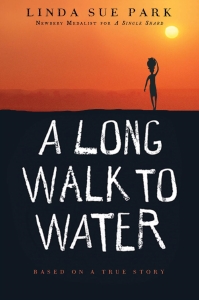 Contrast my sixth-grade boys’ reactions to Linda Sue Park’s A Long Walk to Water, also fiction but based on the true story of eleven-year-old Salva, a “lost boy” of Sudan. The students found the tale’s real-life horror, isolation, and hunger to be much worse than anything in the other disturbing books we had read. While Collins created a fictional reality show of children killing children, many of the lost boys of nonfictional Sudan actually are drugged and forced to murder or be murdered. I had the boys write one-page journal entries at specific junctures in their reading. I assumed, wrongly, that most of them would find it challenging to write an entire page of “reactions/feelings” after every ten pages of the book. Instead, pages of outrage, compassion, and fundraising ideas landed on my desk. This writing was in stark contrast to the kind of blood-spurting, monster-maiming journal writing that was the norm in my classroom.
Perhaps it is their very nature as middle schoolers — one foot in childhood and one foot in adolescence — that gives my students this ability to recognize some stories, even brutally realistic fiction (such as Trash) or violent sci-fi (The Hunger Games) as made-up, not real, thus not really disturbing. Very young children blur the lines between real and make-believe; they pretend for a living. Teenagers are beginning to be mired in the truths of the “real world.” But the tweeners sit, balanced on the edge of the rye field that Holden Caulfield so nobly tends, and can see both sides. They intrinsically know what is pretend and what is not. Preadolescents can handle graphic violence, injustice, and horror that is fabricated, as long as there is the idealistic promise of the good guy winning in the end. (Thus my students’ disappointment with dejected Hunger Games hero, Katniss, who ends with a resigned whimper rather than a heroic bang.) They can, at the same time, be outraged at the stark realities of an adult world that is still too far away for them developmentally to experience.
People often cringe when I tell them I teach middle school boys, a population that seems to be considered the pits of the education world. But I feel grateful to experience “disturbing” books with these boys in the middle. It has allowed me, ever so vicariously, a view from Holden’s field.


Added To Cart
RELATED


RECOMMENDED

Please register with us to continue reading.
ALREADY A SUBSCRIBER? LOG IN
We are currently offering this content for free. Sign up now to activate your personal profile, where you can save articles for future viewing.
ALREADY A SUBSCRIBER? LOG IN
Thank you for visiting.
We’ve noticed you are using a private browser. To continue, please log in or create an account.

Add Comment :-
Comment Policy:
Comment should not be empty !!!
Lana Whited
I'm the editor of two collections of essays about Harry Potter and have a collection of Hunger Games essays coming out next spring. I want to say that this essay is perhaps the best account I have encountered on this particular issue about age. The point about how young people experience literature differently from us "midlife mothers" really says it all. Bruno Bettelheim's arguments about how folktales work for children are really quite similar. Thank you, Christina; this essay will stay with me. Lana Whited editor, The Ivory Tower and Harry Potter, Critical Insights: The Harry Potter Series, and Critical Insights: The Hunger Games SeriesPosted : Nov 30, 2015 02:10
"Disturbing"?!?!?!?
How are these books "disturbing"? Children in the world face REAL situations much worse than can be imagined and yet all people seem to care about is protecting the "fragile" mind of the kids that have it allPosted : Jul 06, 2014 01:26
beth fowler
As a former English teacher at a in Pennsylvania, I recall classroom discussions about the classics: A Separate Peace, Of Mice and Men, To Kill a Mockingbird and others. The best part was students discovering insights that I (and my teacher’s manual) had missed.Posted : Jun 19, 2014 12:57
Junia
I loved this piece and your analysis of why middle schoolers *can* handle these topics. I teach in a co-ed middle school classroom, and I loop with 7th-8th graders. As the kids grow, I also have qualms, especially since the "disturbing factor" seems to correlate with the reading level. My struggle actually has been in getting girls who are great readers, to not just dutifully read. The books that have fascinated them deal with tough subjects like bullying, assault, and domestic violence. I know I've had to explain certain books to parents as well, so I could definitely relate with this article.Posted : Apr 22, 2014 04:44
Becca
I am a freshman in college and stumbled upon your article and I just wanted to say that I think part of the reason children, even ones who passed through elementary, middle, and high with a book glued to her nose, have trouble reading the literature assigned to us, is that we don't feel any special connection to it. We can't identify with the characters or plot because we perceive it as old and outdated, then reading becomes a chore. I don't know about my peers, but I don't remember half of what I was forced to read for school, let alone what it was about.Posted : Sep 19, 2013 07:15