


2018 School Spending Survey Report

Find more great Horn Book content at these links:
Recommended books: reviews and themed booklists
App and e-book reviews
Movie reviews
Event news and recaps
Events calendar
Paper Towns movie review
If Paper Towns, the book by John Green (Dutton, October 2008) were a comedy, it would be Paper Towns, the movie (directed by Jake Schreier; Fox/Temple Hill, July 2015; PG-13).
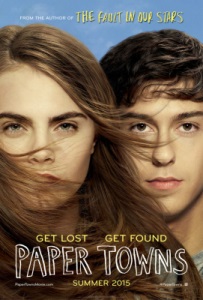 If Paper Towns, the book by John Green (Dutton, October 2008) were a comedy, it would be Paper Towns, the movie (directed by Jake Schreier; Fox/Temple Hill, July 2015; PG-13).
That’s not to say the novel lacks funny moments. It has plenty, and the new film makes good use of them. There are pranks and witty dialogue and teens perhaps occasionally making humorously bad choices, and I laughed a lot. (With, not at, the teens, of course.) The book just offers more to think about.
The story: Quentin Jacobsen, or Q (played by Nat Wolff) and Margo Roth Spiegelman (Cara Delevingne) are neighbors who hung out together as kids. By the end of high school, they’ve drifted apart, but Q still pines for her; he believes that “everyone gets a miracle” and that living next door to Margo is his. The adventurous, unpredictable Margo ropes Q (not that he’s hard to convince) into driving her around and helping with some late-night revenge pranks against her cheating boyfriend and their friends from the popular crowd. After an exhilarating night that ends with a dance, Margo disappears, not for the first time. She leaves clues to her whereabouts, and Q devotes lots and lots of energy to following them. And that’s all I’m going to spoil about that, except to say that there’s an epic and often hilarious road trip that allows costars Austin Abrams (as Ben), Justice Smith (Radar), Halston Sage (Lacey), and Jaz Sinclair (Angela) to shine. (The teens in this movie actually look like teens!)
In both the book and the film, Margo can come off as pretty self-centered: she uses a friend she’s been ignoring for years for his wheels, and then she runs off and expects Q to interpret a string of clues that require him to pay his way into her room, comb through her records and her books, and then visit an abandoned souvenir store across town. The movie tells us she’s dissatisfied with her role as popular girl, but it doesn’t tell us enough to justify the effort Q puts in for her sake, and he just seems like an extreme example of a lovesick puppy. (In case you haven’t gathered as much, this film should not be compared to that other John Green adaptation.)
The novel makes it clearer how unhappy Margo is — during his search, Q even suspects that she may have committed suicide. Including details like that would’ve completely changed the tone of the film, but it also would’ve explained Q’s concern. From a plot standpoint, the book is more suspenseful than the movie, since it raises more possibilities about what may have happened to Margo.
It’s understandable that the movie picks a tone and sticks with it, changing or eliminating plot details when necessary and spending less time than the novel does on introspection. (After all, the movie is not a John Green novel.) If you’re in the mood for an enjoyable teen comedy, this is a decent one. But if you leave confused about the whys and wherefores, you may want to pick up the novel.


Added To Cart
RELATED


RECOMMENDED

Please register with us to continue reading.
ALREADY A SUBSCRIBER? LOG IN
We are currently offering this content for free. Sign up now to activate your personal profile, where you can save articles for future viewing.
ALREADY A SUBSCRIBER? LOG IN
Thank you for visiting.
We’ve noticed you are using a private browser. To continue, please log in or create an account.

Add Comment :-
Be the first reader to comment.
Comment Policy:
Comment should not be empty !!!