


2018 School Spending Survey Report

Find more great Horn Book content at these links:
Recommended books: reviews and themed booklists
App and e-book reviews
Movie reviews
Event news and recaps
Events calendar
The Human Body app review
Last week's edition of Nonfiction Notes offered several recommended books about medicine and the human body (plus books on social change, how things work, indigenous cultures, and geography/cartography).
Begin by selecting from four child avatars. The app's main page then shows your avatar in silhouette; a pull-out toolbar along the left side offers icon representing the body's systems: nervous, skeletal, respiratory, circulatory, digestive, and muscular. Tap on a single icon to see an individual system in place in the child's body, or select multiple icons to see systems working in tandem. Clear diagrams and sound-effect-enhanced animations present the systems in an approachable (often humorous) way.
 the nervous, skeletal, respiratory, circulatory, and digestive systems
Tapping a system icon brings up several sub-icons (e.g., the nervous system menu offers brain, eye, nose, and ear options), allowing you to zoom in on its specific features. Select the brain icon to see its structure in more detail, then tap on the labeled lobes to see representations of their functions (for example, tapping on the cerebral cortex prompts a math equation to pop up). Move a slider bar to view the surfaces of systems' organs, their cross-sections, or a combination of the two.
 the brain's surface (left) and cross-section (right), with the cerebral cortex highlighted
The app also models cause and effect in relation to body systems. Tap an icon of legs at the bottom right and the child avatar goes from standing to a run, illustrating various organs' response to exertion. "Tickle" the child with a feather to see neurological pathways in action, "feed" him or her a variety of foods to witness digestion (including burps and farts), play sounds and watch how the ear drum vibrates, or use the device's camera function to simulate vision — and those are just a few of the many interactive opportunities to try.
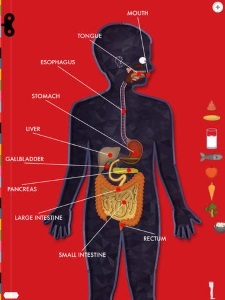 the digestive system — and a selection of foods to "digest"
Since the app is available in a huge range of languages, body part labels are the only text — download the free accompanying Human Body Handbook PDF for information about the systems of the body as well as tips for using the app. A settings icon in the sidebar allows you to turn labels and sound effects on/off and to change the language.
Available for iPhone, iPad, and iPod touch (requires iOS 7.0 or later); $2.99. Recommended for primary users and up.
Through December 7th, partial proceeds from the sale of this app will be donated to the Global Fund to help fight AIDS. Immune system and urogenital system add-ons must be purchased individually ($0.99 each).


Added To Cart
RELATED


RECOMMENDED

Please register with us to continue reading.
ALREADY A SUBSCRIBER? LOG IN
We are currently offering this content for free. Sign up now to activate your personal profile, where you can save articles for future viewing.
ALREADY A SUBSCRIBER? LOG IN
Thank you for visiting.
We’ve noticed you are using a private browser. To continue, please log in or create an account.

Add Comment :-
Be the first reader to comment.
Comment Policy:
Comment should not be empty !!!