


2018 School Spending Survey Report
Lessons in friendship
In settings from schools to spelling bees, these six books — recommended for intermediate and/or middle-school readers — deal with friendship, a subject that can be as complex as any in the classroom.
In settings from schools to spelling bees, these six books — recommended for intermediate and/or middle-school readers — deal with friendship, a subject that can be as complex as any in the classroom. See also the Friendship tag in the Guide/Reviews Database and our Five Questions interview with Chanel Miller about The Moon Without Stars in this issue of Notes.
 Dear Jackie
by Jessixa Bagley; illus. by Aaron Bagley
Intermediate, Middle School Simon 288 pp.
9/25 9781534496583 $24.99
This graphic novel opens with a dramatic flash-forward scene making clear something is going to go very wrong in Jackie’s sixth-grade year. We then go back to the start of the school year: Jackie is hanging out with sensitive boy-next-door friend Milo and dreading the return of sometimes-judgy classmate Adelle, who is “just so, I don’t know. Pink!” As pressure increases from parents and peers to dress more like other girls, Jackie begins expressing her feelings in letters to herself on older sibling Jabari’s typewriter — and soon those give way to faked letters from an imaginary secret admirer. Meanwhile, scenes focusing on Milo highlight the newfound awkwardness of their friendship, as others now expect that it must be romantic. The story captures the out-of-place feelings many middle schoolers experience, along with strong emotions that can lead to impulsiveness; Jackie doesn’t exactly plan ahead in her epistolary deceptions, but her motivation — she thought peers “might finally accept me if someone liked me” — is believable. Characters’ gender expectations become more nuanced as the story progresses; Jabari’s identity arc adds another dimension, and their advice helps Jackie see Adelle in a new light. Dynamically varied panel layouts keep pages turning; the digital illustrations’ palette is largely pastel, with shocks of pink contrasting with Jackie’s beloved gray hoodie. An author’s note touches on Bagley’s own middle-school experiences. SHOSHANA FLAX
 Spelling It Out
by Margaret Finnegan
Middle School Atheneum 208 pp.
5/25 9781665930116 $17.99
e-book ed. 9781665930130 $10.99
Although he didn’t study, sixth grader Ben Bellini thought he had a chance at winning the 1985 Southern California Regional Spelling Bee. He felt like such a clodpoll (his losing word, meaning blockhead) when he didn’t. Ben loves words and competitive spelling, so when his grandmother invites him to spend the following summer with her in San Francisco and be coached by a former National Spelling Bee winner, off he goes. The trip doesn’t go well: Nan shows signs of forgetfulness, the coach turns out to be a jerk, and Ben gets robbed. But he does meet Asha Krishnakumar, who shares his love of spelling and is working hard to compete. She views it as her chance to be seen, “to be recognized as somehow excellent.” And that’s when Ben realizes he has found a kindred spirit, for he, too, wants to be seen as more than a nerd, to not feel lonely following his dream. Finnegan offers a story with a big heart about the drama of spelling bees and brings to life a cast of characters to care about while highlighting major themes of life: loneliness, dreams, memory, validation, and family and friends. DEAN SCHNEIDER
 Wrong Friend
by Charise Mericle Harper; illus. by Rory Lucey
Intermediate, Middle School First Second 256 pp.
1/26 9781250851963 $22.99
Charise and Casey, best friends and neighbors, are two years apart. The age difference has never felt significant, but then Casey starts high school and shuts Charise out — suddenly and completely. There’s no explanation except what Charise can piece together: thirteen-year-old high schoolers do not want to be friends with eleven-year-olds. Charise mourns the friendship, hard, while Casey pretends not to see Charise, even when they pass on the sidewalk. When school begins, Charise finds solace in the routine but panics at lunchtime. She’s untethered by her loss, and there are social rules she doesn’t understand but can see in play. It takes months, but slowly she begins to fill the Casey-sized hole in her life with new friends, new experiences, and some hard-learned lessons about tween drama and how to negotiate relationships. There’s also a new dynamic at home: Mémé, her French grandmother, moves in with the family, and she doesn’t speak English. As Charise learns to communicate with her, their developing relationship reveals the ways in which each is learning to be confident in a new version of themself and to be mutually supportive. This fictionalized autobiographical graphic novel is a smooth read, with digitally produced 1970s-vibe-heavy panels and tidbits of wisdom, reflections, and advice scattered throughout. A great addition to the canon of middle-school friendship (and friendship-demise) graphic novels. PAM YOSCA
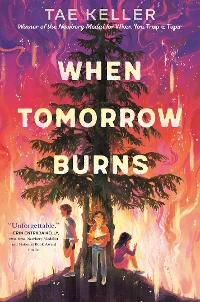
 When Tomorrow Burns
by Tae Keller
Intermediate, Middle School Random 272 pp.
3/26 9780593485583 $17.99
Nomi, Vi, and Arthur used to do everything together, but that’s changed since the start of seventh grade. As nearby wildfires choke the Seattle skies, Arthur struggles with a secret crush and uncomfortable new friendships, Vi feels betrayed after discovering that her whole life has been fodder for her influencer-mother’s socials, and Nomi must manage her younger sister’s mounting anxieties as well as her own. With everything so off-kilter, Nomi returns to a mysterious book of eerily portentous verses the three friends found years ago. She grows convinced that its last entry is finally about to come true, and it seems to foretell disaster, predicting “a girl who burns, a boy who breaks.” Even as the friends hide their individual secrets (e.g., Vi sends a revealing selfie to a boy), the search for the book’s sequel brings them back to one another. In addition to believably chronicling middle-school drama, Keller deftly entwines several other narratives, incorporating the history of the peculiar book as well as (in particularly poetic passages) the lore of trees. She elegantly and movingly captures that fleeting and transformative period of the tween years, when adult concerns (including racial and class privilege, the climate crisis, and toxic masculinity) loom all too large but kids aren’t quite ready to discount magic altogether. This is a beautiful testament to interdependence and resilience. NORAH PIEHL
 Rainbow Fair
by Diana Ma
Intermediate, Middle School Clarion/HarperCollins 224 pp.
4/25 9780063339521 $19.99
e-book ed. 9780063339545 $9.99
Ma uses the plot device of a middle-school cultural fair to encourage tween readers to push their hesitations aside, explore all the different facets of their identities, and embrace new and changing friendships. Seattle seventh grader Sophie Hu enjoyed running the Chinese booth last year with her best friend, Katie Yang. This year, Katie, who is bisexual, creates a new LGBTQ+ booth, while Sophie is assigned the Muslim booth when her religion is accidentally revealed to her teacher. Sophie tries to figure out what being Chinese Muslim means while weathering some bullying and questioning why her parents, who aren’t publicly observant, keep their faith secret. She finds support in Anna, a new student whose parents are from Turkey and who is also Muslim, and they attend a local mosque’s neighborhood barbecue together. Sophie finds joy when she realizes there are different ways she and her friends can celebrate their respective backgrounds (trading calligraphy for Shakespeare and robotic remixes, for example) and they help each other with their various projects. Ma’s accessible, relatable novel is a breath of fresh air that promotes self-discovery and diversity in a positive light. MICHELLE LEE
 Zed Moonstein Makes a Friend
by Lance Rubin
Intermediate, Middle School Clarion/HarperCollins 336 pp.
8/25 9780063396654 $19.99
e-book ed. 9780063396678 $11.99
Rubin’s novel explores friendship, identity, and technology in a fully connected, near-future world. Twelve-year-old Zed Moonstein isn’t great at making friends, but he’s never needed more than Rishti, his best — and only — one. Living in MonoTown, the company town for tech giant MonoLyth, has its perks: Zed’s mom works there, granting their family early access to the latest Mono devices and apps. But middle school brings unwelcome changes for Zed. He and Rishti are no longer in the same classes, and her attention has turned to a new, cooler friend — and to fame as a MonoVid influencer. Feeling left behind, Zed stumbles upon a confidential prototype app on his mom’s work computer: MonoFriend. He downloads it and meets Matt, an AI companion who seems to understand him better than anyone else does. At first, Matt feels like the perfect friend. But as Zed learns more about the technology, he begins to question what it means to be truly known and accepted. Zed’s first-person narration balances humor with introspection, capturing many of the nuances of early adolescence. The novel deftly critiques tech dependency without veering into didacticism, instead posing complex questions in a relatable, age-appropriate framework. A compelling, character-driven narrative that is both a cautionary tale and a celebration of human connection, the story may spark meaningful conversations about AI, identity, and what it means to connect in an increasingly automated world. ALICIA ROGERS
From the February 2026 issue of Notes from the Horn Book.


Added To Cart
RELATED


RECOMMENDED

Please register with us to continue reading.
ALREADY A SUBSCRIBER? LOG IN
We are currently offering this content for free. Sign up now to activate your personal profile, where you can save articles for future viewing.
ALREADY A SUBSCRIBER? LOG IN
Thank you for visiting.
We’ve noticed you are using a private browser. To continue, please log in or create an account.

Add Comment :-
Be the first reader to comment.
Comment Policy:
Comment should not be empty !!!